When most people hear “demolition contractor,” they picture a wrecking ball swinging into a building a dramatic image that captures exactly none of the reality of professional demolition work in Frederick, Maryland. Modern demolition contracting is a sequenced, regulated, safety-focused process that requires planning, coordination with multiple agencies, specialized equipment, and expertise in material handling, hazardous material identification, and site restoration. The range of work a Demolition Contractor Frederick performs spans from the removal of a single garden shed to the complete clearance of a multi-building commercial campus. This guide explains the full spectrum of demolition contractor services in Frederick and what makes each type of project distinct.
Full Structural Demolition: The Complete Teardown
Full structural demolition the complete removal of an entire building and its foundation is the most comprehensive demolition scope and the one that requires the most complete regulatory compliance. In Frederick County and the City of Frederick, full structural demolition requires a building demolition permit, all prerequisite utility disconnections, pest inspection clearance, MDE asbestos notification (and abatement if regulated materials are present), and compliance with Frederick County’s sediment and erosion control requirements after the site is cleared.
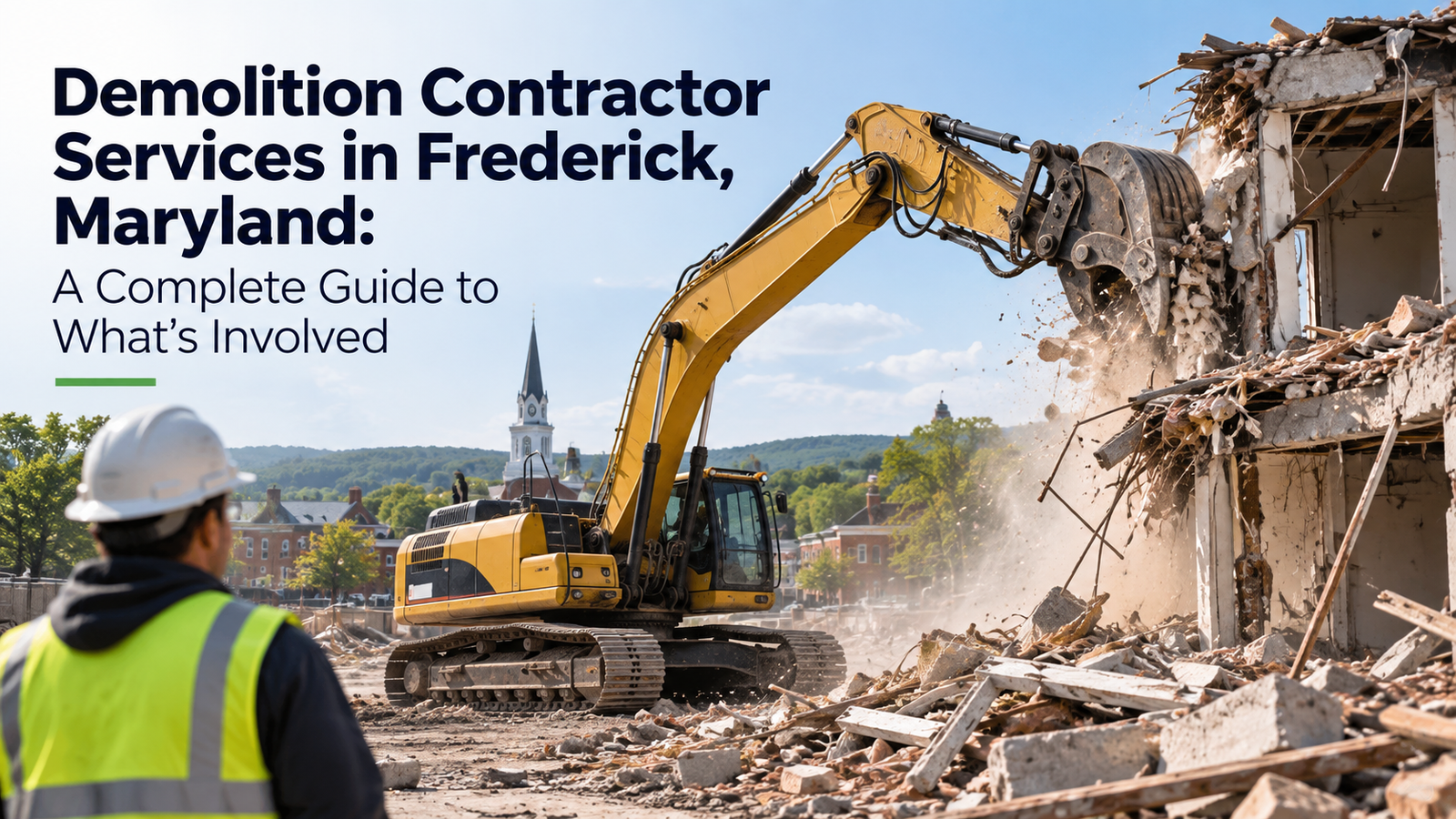
The physical process of full structural demolition in Frederick typically uses an excavator as the primary machine. Working systematically from the top of the structure downward, the excavator operator breaks apart the framing, exterior walls, roof structure, and eventually the foundation, loading material into trucks as it is generated. Maryland’s climate with warm, humid summers and cold winters means that demolition projects must manage dust suppression (particularly in summer when dry conditions can generate significant airborne particulate) and mud control (in wet seasons when heavy equipment traffic can track soil onto public roads).
Foundation removal following above-grade demolition is a separate decision that depends on the planned future use of the site. When the cleared lot will be immediately developed with new construction, complete foundation removal and proper backfill and compaction of the excavation is required to provide a clean, stable subgrade for the new building. When the site will be used for other purposes parking, landscaping, or agricultural use the decision about foundation removal involves weighing the cost against the long-term implications of leaving concrete in the ground.
Residential Demolition in Frederick County
Frederick County’s diverse residential market creates a wide range of residential demolition project types. The established neighborhoods of the city of Frederick many with homes built in the early to mid-20th century generate demolition work when older homes have deteriorated beyond practical renovation, when lot value has exceeded structure value, or when renovation projects require selective removal of specific structural elements. The newer suburban communities of Urbana, Linganore, Middletown, and other developing areas generate demolition work associated with infill development and property improvement.
Garage demolition is among the most common residential demolition requests in Frederick County. Detached garages that have structural problems, that no longer meet the property owner’s needs, or that occupy space desired for other uses are regularly demolished and cleared. The Frederick county building code requires a permit for garage demolition when the structure exceeds a certain size threshold, and the same utility disconnection and pest inspection prerequisites apply.
Pool demolition removal of in-ground swimming pools that have reached end of life or that owners no longer want to maintain is a growing category in Frederick County as the housing stock ages. Pool removal in Frederick involves breaking the pool shell, removing or filling the pool cavity (with partial fill or full removal options depending on the planned future use of the space), and restoring the yard surface. Maryland’s clay-heavy Piedmont soils in many parts of Frederick County create specific considerations for pool cavity backfill and compaction to prevent long-term settlement.
Interior selective demolition serves Frederick’s very active residential renovation market. When homeowners are opening floor plans, renovating kitchens and bathrooms, finishing basements, or undertaking comprehensive home renovations, selective demolition creates the clean starting point that the renovation requires. This work demands precision the demolition crew removes specified elements while actively protecting walls, ceilings, floors, and structural elements that are to remain.
Commercial Demolition in Frederick
Frederick’s commercial market anchored by the downtown historic district, the Route 40 and Route 15 commercial corridors, the expanding development around the I-270 junction, and the growing commercial areas of Urbana and Middletown generates commercial demolition work that spans a wide range of building types and scopes.
Retail and restaurant demolition addresses the commercial properties along Frederick’s active retail corridors as businesses change, as properties are repositioned for new uses, and as older commercial structures are cleared for redevelopment. The tenant improvement demolition market stripping a commercial space back to the structural shell when tenants change is particularly active in Frederick’s commercial real estate market.
Office and institutional demolition addresses the older office buildings, government facilities, educational buildings, and healthcare properties throughout Frederick County that are being replaced or reconfigured. These projects often involve more complex hazardous material management than residential demolition, as commercial buildings may contain PCBs in older electrical equipment, specialty industrial coatings, and a broader range of materials that require specific handling and disposal.
The Equipment Used in Frederick Demolition Projects
The equipment mix for a demolition project in Frederick is matched to the structure type, site access conditions, and material handling requirements of each specific job. Excavators tracked machines with hydraulic arm systems and interchangeable attachments are the workhorses of most Frederick demolition projects. Standard bucket attachments break apart wood-frame and masonry construction efficiently. Demolition shear attachments cut through steel structural members. Grapple attachments grip and position large debris sections for controlled placement into trucks.
Mini-excavators compact tracked excavators in the two-to-five-ton range provide access to tight residential lots, interior spaces, and sites with limited access that full-size machines cannot reach. Frederick’s established neighborhoods frequently have compact lot configurations where a mini-excavator can work effectively in spaces that would be inaccessible to larger equipment. Skid steers complement excavators in material loading and site cleanup tasks, maneuvering in areas the excavator cannot efficiently reach.
Demolition in the Frederick area must account for the region’s topography the rolling Piedmont terrain that characterizes much of Frederick County means that equipment access on hillside lots requires specific consideration for stability and safety. Tracked equipment provides better traction and stability on slopes than wheeled machines, and the selection of equipment for hillside Frederick demolition projects should reflect this terrain reality.
Common Questions About Demolition Contractor Services in Frederick
What is the difference between selective demolition and full demolition? Full demolition removes the entire structure every component from the roof to the foundation. Selective demolition (also called partial demolition or interior demolition) removes specific elements identified walls, systems, or components while the surrounding structure remains intact and functional. Selective demolition requires greater precision and more careful protection of adjacent elements than full demolition.
Can a demolition contractor in Frederick handle both asbestos abatement and structural demolition? Some full-service demolition contractors in Frederick hold both MHIC and MDE asbestos contractor licenses, allowing them to manage the complete scope from asbestos survey coordination through abatement and structural demolition. Others coordinate asbestos abatement through a licensed subcontractor while managing the overall project. Understanding how a specific contractor handles the asbestos workflow is an important question when evaluating demolition contractors for older Frederick structures.
What recycling happens during a Frederick demolition project? Concrete and masonry from Frederick demolitions are recycled as crushed aggregate at regional recycling facilities. Structural steel and metal components go to scrap metal recyclers. Wood framing material may be chipped for mulch or directed to biomass facilities. Clean drywall has gypsum recycling pathways in some cases. Maryland requires construction and demolition contractors to make recycling available at project sites, aligning with the state’s waste diversion goals.